Shop
Shop
-
Code Your First Game Arcade Classic in JavaScript on Canvas
Original price was: $19.99.$5.99Current price is: $5.99.Have you ever wanted to create your own video game but didn’t know where to start? This beginner-friendly course provides a practical introduction to game development using JavaScript and HTML5 Canvas. Through the creation of a classic arcade-style paddle and ball game, learners will gain hands-on experience with the core concepts that power modern games while building a fully playable project from scratch. The course begins by introducing essential game development fundamentals, including drawing objects on the Canvas, understanding coordinates and positioning, implementing movement, handling time-based animations, and organizing code effectively. These foundational concepts help learners understand how interactive games are built and how game objects behave within a virtual environment. As the course progresses, learners will develop the game’s core mechanics by implementing ball movement, paddle controls, collision detection, scoring systems, and simple artificial intelligence for the opponent paddle. These lessons demonstrate how different game components work together to create engaging and responsive gameplay. Learners will also gain valuable experience working with real-time updates, player interaction, and game logic. In the final section, the focus shifts toward polishing and enhancing the game experience. Learners will improve ball control mechanics, create winning conditions, add mouse interactions, design visual elements such as the center net, and explore additional ideas for expanding the project further. These improvements transform the project from a simple prototype into a complete arcade-style game. By the end of the course, learners will have built a fully functional browser-based game while developing a solid understanding of JavaScript programming, HTML5 Canvas rendering, animation systems, collision handling, user input management, and basic game design principles. The skills gained throughout this course provide an excellent foundation for creating more advanced games and interactive web applications in the future. What You Will Learn Build a complete arcade-style game using JavaScript Work with HTML5 Canvas for graphics rendering Understand object positioning and coordinate systems Implement smooth animations and game loops Create ball movement and paddle controls Detect collisions between game objects Develop scoring and winning systems Build simple AI-controlled opponents Handle mouse interactions and player input Organize and structure game code effectively Improve gameplay through visual and functional enhancements Gain practical experience in browser-based game development Key Topics Covered JavaScript Game Development Fundamentals HTML5 Canvas API Drawing and Rendering Graphics Animation and Game Loops Ball Physics and Motion Paddle Mechanics Collision Detection Scoring Systems Artificial Intelligence Basics User Input Handling Game State Management Code Optimization and Refactoring Arcade Game Design Principles Who Should Take This Course? This course is ideal for: Complete beginners interested in game development JavaScript learners seeking practical projects Students exploring programming concepts Web developers interested in HTML5 Canvas Hobbyists who want to build their first game Anyone curious about how arcade games are created No prior game development experience is required. Basic familiarity with JavaScript is helpful but not mandatory. Learning Outcomes By the end of this course, learners will be able to: Build interactive browser-based games using JavaScript Use HTML5 Canvas to render graphics and animations Create game objects and control their behavior Implement collision detection and scoring systems Develop simple game AI opponents Manage user input and game interactions Structure and organize game code effectively Design and complete a playable arcade game project Final Outcome Upon completing this course, learners will have successfully developed a fully playable arcade-style game using JavaScript and HTML5 Canvas. More importantly, they will gain practical experience with the core principles of game development, providing a strong foundation for building more advanced games, interactive applications, and future programming projects.View course -
Complete Pyomo Bootcamp. Python Optimization
Original price was: $44.99.$14.99Current price is: $14.99.Pyomo Bootcamp: Python Optimization The Pyomo Bootcamp: Python Optimization course is designed to introduce participants to the world of optimization using the powerful Pyomo library in Python. Pyomo is an open-source Python-based optimization modeling tool that is widely used for solving linear, mixed-integer, nonlinear, and dynamic optimization problems. This bootcamp is structured to provide both theoretical understanding and hands-on practice in optimization techniques. Course Overview: In this bootcamp, participants will learn how to formulate and solve optimization models using Pyomo, focusing on different types of problems that commonly arise in real-world applications. Whether you’re working in logistics, finance, supply chain management, energy, or any other field that requires decision-making based on complex constraints and objectives, this course will equip you with the skills to tackle these challenges. Key Features: Introduction to Pyomo: Overview of the Pyomo library and its capabilities. Understanding the basic structure of Pyomo models. Installing Pyomo and setting up the development environment. Optimization Problem Formulation: How to define and structure optimization problems using Pyomo. Understanding variables, objectives, and constraints in the context of optimization models. Introduction to different types of optimization problems (Linear, Nonlinear, Mixed-Integer, etc.). Linear and Mixed-Integer Programming (LP & MILP): Solving linear optimization problems (LP). Working with mixed-integer linear programming (MILP) to model problems with discrete decisions. Practical applications of LP and MILP in industries like supply chain management, resource allocation, and scheduling. Nonlinear Programming (NLP): Modeling and solving nonlinear optimization problems. Exploring techniques for handling nonlinearity in both objectives and constraints. Real-world examples where nonlinear optimization is essential (e.g., engineering design, machine learning). Dynamic Optimization and Time-dependent Models: Understanding dynamic optimization problems. Handling time-dependent constraints and objectives. Using Pyomo to model systems that evolve over time, such as transportation logistics and energy planning. Solver Integration: Introduction to different solvers that work with Pyomo. Learning how to interface with open-source and commercial solvers (e.g., GLPK, CBC, CPLEX, Gurobi). Tips and techniques for improving solver performance and handling large-scale problems. Hands-on Projects and Case Studies: Building real-world optimization models step by step. Working on practical case studies from various domains (e.g., transportation, manufacturing, finance). Implementing optimization solutions and analyzing results for decision-making. Advanced Topics (Optional): Sensitivity analysis and post-optimization analysis. Advanced modeling techniques like stochastic programming or multi-objective optimization. Tips for scaling optimization problems to handle large datasets or complex models. Who Should Take This Course? Data Scientists and Analysts who want to incorporate optimization techniques into their data-driven decision-making processes. Operations Researchers interested in solving complex optimization problems more efficiently. Engineers and Technicians dealing with resource allocation, scheduling, and design problems. Business Analysts and Decision Makers looking to optimize financial and operational decisions in various industries. Researchers and Academics who need to apply optimization methods in their studies or research. Learning Outcomes: By the end of the Pyomo Bootcamp, participants will be able to: Formulate optimization problems and translate them into Pyomo models. Understand the different types of optimization problems (linear, nonlinear, mixed-integer) and how to solve them. Use Pyomo to model complex, real-world decision-making scenarios. Interact with various solvers and optimize solutions for large-scale problems. Apply optimization concepts to improve efficiency, reduce costs, and make better decisions in various industries. Course Delivery: This course typically involves a mix of: Video Lectures: Theory, modeling concepts, and practical explanations. Hands-on Coding Exercises: Writing and running Pyomo code in Python. Project Work: Implementing real-world optimization projects and solving case studies. Q&A and Discussion: Engaging with instructors and peers to clarify doubts and share insights. Overall, the Pyomo Bootcamp: Python Optimization course provides a comprehensive foundation for mastering optimization techniques with Pyomo in Python, helping you tackle complex optimization problems effectively.View course -
Complete Pyomo Bootcamp. Python Optimization
Original price was: $44.99.$14.99Current price is: $14.99.Pyomo Bootcamp: Python Optimization The Pyomo Bootcamp: Python Optimization course is designed to introduce participants to the world of optimization using the powerful Pyomo library in Python. Pyomo is an open-source Python-based optimization modeling tool that is widely used for solving linear, mixed-integer, nonlinear, and dynamic optimization problems. This bootcamp is structured to provide both theoretical understanding and hands-on practice in optimization techniques. Course Overview: In this bootcamp, participants will learn how to formulate and solve optimization models using Pyomo, focusing on different types of problems that commonly arise in real-world applications. Whether you’re working in logistics, finance, supply chain management, energy, or any other field that requires decision-making based on complex constraints and objectives, this course will equip you with the skills to tackle these challenges. Key Features: Introduction to Pyomo: Overview of the Pyomo library and its capabilities. Understanding the basic structure of Pyomo models. Installing Pyomo and setting up the development environment. Optimization Problem Formulation: How to define and structure optimization problems using Pyomo. Understanding variables, objectives, and constraints in the context of optimization models. Introduction to different types of optimization problems (Linear, Nonlinear, Mixed-Integer, etc.). Linear and Mixed-Integer Programming (LP & MILP): Solving linear optimization problems (LP). Working with mixed-integer linear programming (MILP) to model problems with discrete decisions. Practical applications of LP and MILP in industries like supply chain management, resource allocation, and scheduling. Nonlinear Programming (NLP): Modeling and solving nonlinear optimization problems. Exploring techniques for handling nonlinearity in both objectives and constraints. Real-world examples where nonlinear optimization is essential (e.g., engineering design, machine learning). Dynamic Optimization and Time-dependent Models: Understanding dynamic optimization problems. Handling time-dependent constraints and objectives. Using Pyomo to model systems that evolve over time, such as transportation logistics and energy planning. Solver Integration: Introduction to different solvers that work with Pyomo. Learning how to interface with open-source and commercial solvers (e.g., GLPK, CBC, CPLEX, Gurobi). Tips and techniques for improving solver performance and handling large-scale problems. Hands-on Projects and Case Studies: Building real-world optimization models step by step. Working on practical case studies from various domains (e.g., transportation, manufacturing, finance). Implementing optimization solutions and analyzing results for decision-making. Advanced Topics (Optional): Sensitivity analysis and post-optimization analysis. Advanced modeling techniques like stochastic programming or multi-objective optimization. Tips for scaling optimization problems to handle large datasets or complex models. Who Should Take This Course? Data Scientists and Analysts who want to incorporate optimization techniques into their data-driven decision-making processes. Operations Researchers interested in solving complex optimization problems more efficiently. Engineers and Technicians dealing with resource allocation, scheduling, and design problems. Business Analysts and Decision Makers looking to optimize financial and operational decisions in various industries. Researchers and Academics who need to apply optimization methods in their studies or research. Learning Outcomes: By the end of the Pyomo Bootcamp, participants will be able to: Formulate optimization problems and translate them into Pyomo models. Understand the different types of optimization problems (linear, nonlinear, mixed-integer) and how to solve them. Use Pyomo to model complex, real-world decision-making scenarios. Interact with various solvers and optimize solutions for large-scale problems. Apply optimization concepts to improve efficiency, reduce costs, and make better decisions in various industries. Course Delivery: This course typically involves a mix of: Video Lectures: Theory, modeling concepts, and practical explanations. Hands-on Coding Exercises: Writing and running Pyomo code in Python. Project Work: Implementing real-world optimization projects and solving case studies. Q&A and Discussion: Engaging with instructors and peers to clarify doubts and share insights. Overall, the Pyomo Bootcamp: Python Optimization course provides a comprehensive foundation for mastering optimization techniques with Pyomo in Python, helping you tackle complex optimization problems effectively.Add to cart -
CSS – Basics To Advanced for front end development
Original price was: $44.99.$14.99Current price is: $14.99.CSS – Basics to Advanced for Front-End Development This comprehensive course on CSS (Cascading Style Sheets) takes you from beginner to advanced levels, providing you with the skills needed to design visually appealing, responsive, and modern websites. Perfect for aspiring front-end developers or anyone looking to enhance their CSS knowledge, this course covers everything you need to master CSS and use it efficiently in web development. Course Description: In this course, you will start by learning the fundamentals of CSS, such as syntax, selectors, properties, and values. You’ll understand how CSS integrates with HTML to style your web pages and make them interactive and attractive. As you progress, you’ll dive into more advanced concepts like: Responsive Web Design: Learn how to create websites that work perfectly across all screen sizes, from mobile devices to large desktop monitors. This section covers techniques such as media queries, flexible layouts, and fluid grids. CSS Flexbox: Master the Flexbox layout system to create complex, responsive layouts with minimal code. Flexbox makes it easy to align, distribute space, and manage elements within a container. CSS Grid: Discover how to create sophisticated grid layouts with CSS Grid, giving you fine control over both rows and columns to design multi-column layouts without relying on external frameworks. Advanced Styling Techniques: Dive deep into topics like CSS transitions, animations, transformations, and pseudo-classes to bring your web designs to life. Learn how to create smooth, interactive animations and user-friendly interfaces. CSS Frameworks: Familiarize yourself with popular CSS frameworks like Bootstrap and Tailwind CSS that streamline the design process and help you build websites faster and more efficiently. Best Practices: Learn how to write clean, organized CSS code with proper naming conventions, comments, and reusable components, ensuring maintainable and scalable web applications. Preprocessors: Understand how to use CSS preprocessors like SASS or LESS to streamline the styling process with variables, mixins, nesting, and more. What You’ll Learn: Basic CSS properties like colors, fonts, margins, padding, and borders How to apply CSS to HTML elements and manipulate their layout and design Advanced layout techniques with Flexbox and Grid How to make your websites responsive for mobile, tablet, and desktop views CSS animations and transitions to create interactive user experiences The use of CSS frameworks to speed up development How to structure and organize CSS for better maintainability Using CSS preprocessors like SASS to write more efficient and dynamic styles Who This Course is For: Beginners: If you’re new to web development and want to learn how to style websites, this course is perfect for you. Intermediate Developers: If you already have basic CSS knowledge and want to deepen your skills with more advanced topics, this course will elevate your expertise. Front-End Developers: If you’re looking to enhance your front-end development toolkit and stay up-to-date with industry best practices, this course is essential. Course Format: This course is structured in bite-sized modules with practical exercises, quizzes, and projects to help reinforce your learning. By the end of the course, you will have built several real-world projects, showcasing your CSS skills and preparing you for professional front-end development. Why Take This Course? Comprehensive Content: Covers everything from the basics to the most advanced topics in CSS. Real-World Applications: Learn by working on real-world projects that you can showcase in your portfolio. Interactive Learning: Practice through hands-on exercises and coding challenges. Expert Instructors: Learn from experienced professionals who have worked in the web development industry. By the end of the course, you will have the confidence to build beautiful, responsive websites from scratch, setting you on the path to becoming a skilled front-end developer.View course -
CSS – Basics To Advanced for front end development
Original price was: $44.99.$14.99Current price is: $14.99.CSS – Basics to Advanced for Front-End Development This comprehensive course on CSS (Cascading Style Sheets) takes you from beginner to advanced levels, providing you with the skills needed to design visually appealing, responsive, and modern websites. Perfect for aspiring front-end developers or anyone looking to enhance their CSS knowledge, this course covers everything you need to master CSS and use it efficiently in web development. Course Description: In this course, you will start by learning the fundamentals of CSS, such as syntax, selectors, properties, and values. You’ll understand how CSS integrates with HTML to style your web pages and make them interactive and attractive. As you progress, you’ll dive into more advanced concepts like: Responsive Web Design: Learn how to create websites that work perfectly across all screen sizes, from mobile devices to large desktop monitors. This section covers techniques such as media queries, flexible layouts, and fluid grids. CSS Flexbox: Master the Flexbox layout system to create complex, responsive layouts with minimal code. Flexbox makes it easy to align, distribute space, and manage elements within a container. CSS Grid: Discover how to create sophisticated grid layouts with CSS Grid, giving you fine control over both rows and columns to design multi-column layouts without relying on external frameworks. Advanced Styling Techniques: Dive deep into topics like CSS transitions, animations, transformations, and pseudo-classes to bring your web designs to life. Learn how to create smooth, interactive animations and user-friendly interfaces. CSS Frameworks: Familiarize yourself with popular CSS frameworks like Bootstrap and Tailwind CSS that streamline the design process and help you build websites faster and more efficiently. Best Practices: Learn how to write clean, organized CSS code with proper naming conventions, comments, and reusable components, ensuring maintainable and scalable web applications. Preprocessors: Understand how to use CSS preprocessors like SASS or LESS to streamline the styling process with variables, mixins, nesting, and more. What You’ll Learn: Basic CSS properties like colors, fonts, margins, padding, and borders How to apply CSS to HTML elements and manipulate their layout and design Advanced layout techniques with Flexbox and Grid How to make your websites responsive for mobile, tablet, and desktop views CSS animations and transitions to create interactive user experiences The use of CSS frameworks to speed up development How to structure and organize CSS for better maintainability Using CSS preprocessors like SASS to write more efficient and dynamic styles Who This Course is For: Beginners: If you’re new to web development and want to learn how to style websites, this course is perfect for you. Intermediate Developers: If you already have basic CSS knowledge and want to deepen your skills with more advanced topics, this course will elevate your expertise. Front-End Developers: If you’re looking to enhance your front-end development toolkit and stay up-to-date with industry best practices, this course is essential. Course Format: This course is structured in bite-sized modules with practical exercises, quizzes, and projects to help reinforce your learning. By the end of the course, you will have built several real-world projects, showcasing your CSS skills and preparing you for professional front-end development. Why Take This Course? Comprehensive Content: Covers everything from the basics to the most advanced topics in CSS. Real-World Applications: Learn by working on real-world projects that you can showcase in your portfolio. Interactive Learning: Practice through hands-on exercises and coding challenges. Expert Instructors: Learn from experienced professionals who have worked in the web development industry. By the end of the course, you will have the confidence to build beautiful, responsive websites from scratch, setting you on the path to becoming a skilled front-end developer.Add to cart -
Cyber Security and Ethical Hacking introduction course
Original price was: $44.99.$14.99Current price is: $14.99.Cyber Security and Ethical Hacking Introduction Course Course Description: The Cyber Security and Ethical Hacking Introduction Course is designed for individuals who want to dive into the world of cybersecurity and ethical hacking. This course is ideal for beginners and provides a solid foundation for understanding how to protect networks, systems, and sensitive data from cyber threats, as well as how ethical hackers use their skills to detect vulnerabilities and defend against attacks. In this course, you will: Understand Cybersecurity Fundamentals: Gain a comprehensive overview of cybersecurity, including its key concepts, threats, and the importance of cybersecurity in the digital world. Learn About Ethical Hacking: Understand the role of ethical hackers, also known as “white hats,” who identify and fix security vulnerabilities before malicious hackers can exploit them. Explore Cyber Threats and Attacks: Learn about various types of cyber threats, including malware, ransomware, phishing, and social engineering, and how they affect individuals, businesses, and governments. Get Familiar with Tools & Techniques: Discover popular cybersecurity tools and techniques used by ethical hackers to identify vulnerabilities, assess risks, and prevent attacks. Network Security Basics: Understand how to protect and secure networks, firewalls, encryption, and VPNs, and how to detect unauthorized access and attacks. Ethical Hacking Methodology: Learn the steps involved in conducting an ethical hack, including reconnaissance, scanning, exploitation, and reporting findings. Introduction to Legal and Ethical Considerations: Explore the legal and ethical responsibilities of an ethical hacker, ensuring that their actions are always authorized and within the bounds of the law. By the end of this course, you will have a solid understanding of the basics of cybersecurity and ethical hacking, along with the knowledge to pursue further studies and certifications in the field. Whether you’re interested in a career in cybersecurity, want to protect your own data, or just have an interest in ethical hacking, this course will provide you with the foundational skills and knowledge to get started.Add to cart -
Cyber Security and Ethical Hacking introduction course
Original price was: $44.99.$14.99Current price is: $14.99.Cyber Security and Ethical Hacking Introduction Course Course Description: The Cyber Security and Ethical Hacking Introduction Course is designed for individuals who want to dive into the world of cybersecurity and ethical hacking. This course is ideal for beginners and provides a solid foundation for understanding how to protect networks, systems, and sensitive data from cyber threats, as well as how ethical hackers use their skills to detect vulnerabilities and defend against attacks. In this course, you will: Understand Cybersecurity Fundamentals: Gain a comprehensive overview of cybersecurity, including its key concepts, threats, and the importance of cybersecurity in the digital world. Learn About Ethical Hacking: Understand the role of ethical hackers, also known as “white hats,” who identify and fix security vulnerabilities before malicious hackers can exploit them. Explore Cyber Threats and Attacks: Learn about various types of cyber threats, including malware, ransomware, phishing, and social engineering, and how they affect individuals, businesses, and governments. Get Familiar with Tools & Techniques: Discover popular cybersecurity tools and techniques used by ethical hackers to identify vulnerabilities, assess risks, and prevent attacks. Network Security Basics: Understand how to protect and secure networks, firewalls, encryption, and VPNs, and how to detect unauthorized access and attacks. Ethical Hacking Methodology: Learn the steps involved in conducting an ethical hack, including reconnaissance, scanning, exploitation, and reporting findings. Introduction to Legal and Ethical Considerations: Explore the legal and ethical responsibilities of an ethical hacker, ensuring that their actions are always authorized and within the bounds of the law. By the end of this course, you will have a solid understanding of the basics of cybersecurity and ethical hacking, along with the knowledge to pursue further studies and certifications in the field. Whether you’re interested in a career in cybersecurity, want to protect your own data, or just have an interest in ethical hacking, this course will provide you with the foundational skills and knowledge to get started.View course -
Dimensionality Reduction for Machine Learning
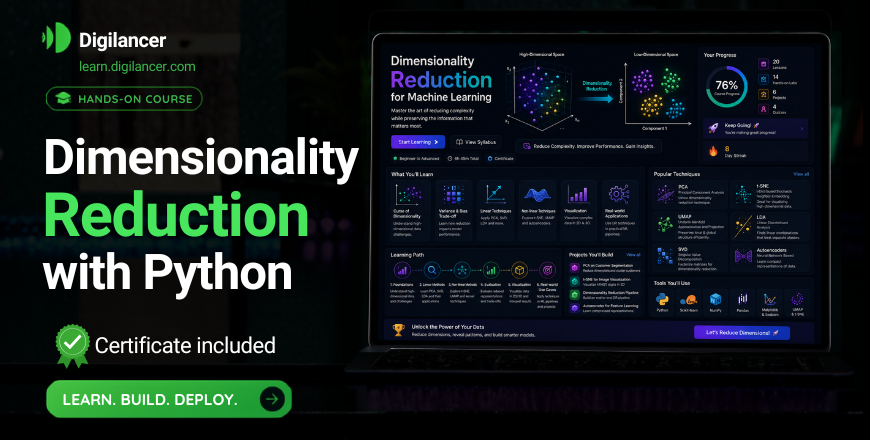
Original price was: $34.99.$9.99Current price is: $9.99.Dimensionality Reduction for Machine Learning is a comprehensive, practical course designed to help learners understand and apply advanced techniques for reducing the complexity of high-dimensional datasets. In modern data science, datasets often contain thousands of features, making analysis computationally expensive, time-consuming, and difficult to interpret. This course provides structured methods to simplify such datasets while preserving meaningful information and improving model performance. The course begins with the fundamentals of dimensionality reduction, explaining why it is necessary in real-world machine learning applications and how it helps address challenges such as high computational cost, redundant features, and poor visualization. Learners are introduced to key concepts such as feature selection and feature extraction, forming the foundation for more advanced techniques. As the course progresses, students explore feature selection methods, including filter-based techniques like missing value ratio, low variance filtering, and correlation analysis, as well as wrapper-based methods such as forward selection, backward elimination, and Random Forest-based feature importance. These techniques help learners identify the most relevant features for building efficient and accurate machine learning models. The course then moves into feature extraction techniques, where learners study how new features can be generated from existing data. Techniques such as Factor Analysis, Principal Component Analysis (PCA), Independent Component Analysis (ICA), and Singular Value Decomposition (SVD) are explained in detail with practical Python implementations using real datasets, including image-based data like Fashion MNIST. In the final section, learners explore projection-based dimensionality reduction techniques, focusing on manifold learning approaches such as ISOMAP and t-SNE. These advanced methods help uncover hidden structures in non-linear datasets and are widely used for visualization and pattern discovery in high-dimensional data. Throughout the course, each concept is supported with practical coding examples, visualizations, and real-world applications to ensure strong conceptual clarity and hands-on understanding. By the end of this course, learners will be able to confidently reduce dimensionality in datasets using multiple techniques, improve model efficiency, enhance visualization, and apply the most appropriate method depending on the problem type. This course builds a strong foundation for advanced machine learning, data science, and AI workflows. What You Will Learn Fundamentals of dimensionality reduction Difference between feature selection and feature extraction Filter, wrapper, and embedded feature selection methods PCA, ICA, SVD, and Factor Analysis Manifold learning techniques (ISOMAP, t-SNE) How to visualize high-dimensional data How to improve model performance using fewer features Practical implementation using Python Skills You Will Gain Data preprocessing and feature engineering High-dimensional data handling Model optimization techniques Data visualization for complex datasets Python-based machine learning implementation Analytical thinking for feature selection Real-world ML workflow design Who This Course Is For? Beginners in Data Science and Machine Learning Students working on ML or AI projects Data analysts and engineers Professionals handling large datasets Anyone interested in feature engineering and model optimization Course Outcome After completing this course, learners will be able to efficiently reduce dataset complexity using modern dimensionality reduction techniques, select the most relevant features, and transform high-dimensional data into meaningful lower-dimensional representations. They will also gain practical experience in applying these techniques using Python and visualizing data for better insights and decision-making.View course -
Easy YouTube Google Ads – Marketing and Advertising Traffic
Original price was: $19.99.$9.99Current price is: $9.99.Easy YouTube Google Ads – Marketing and Advertising Traffic This comprehensive course is designed for anyone looking to leverage the power of Google Ads and YouTube to enhance their online marketing strategy and increase traffic to their business. Whether you’re a small business owner, entrepreneur, digital marketer, or someone new to the world of online advertising, this course breaks down the steps needed to create successful, high-converting campaigns with ease. What You’ll Learn: Google Ads Account Setup & Optimization: Learn how to create, configure, and optimize your Google Ads account, ensuring your ads run smoothly and reach your ideal audience. From setting your campaign budget to understanding the Google Ads interface, this course guides you through the entire process. Creating Effective YouTube Ads: Discover how to create compelling YouTube video ads that grab attention within the first few seconds. You will understand how to structure your ads, write the perfect script, and edit videos to ensure they are eye-catching, engaging, and persuasive. Targeting & Audience Segmentation: Learn how to strategically target your audience on Google and YouTube. The course covers various targeting techniques such as location, demographics, interests, and behaviors, helping you reach the right people at the right time. Crafting the Perfect Ad Copy: Writing ad copy that converts is key to any advertising campaign. This course provides insights into crafting copy that resonates with your audience, drives clicks, and boosts conversions. Ad Types and Formats: You’ll explore different types of YouTube ads such as skippable, non-skippable, bumper ads, and discovery ads. You will also learn about Google Search and Display Network ads, and how to determine which ad format is best for your goals. Effective Landing Pages & Conversions: Once you’ve attracted traffic with your ads, you need a high-converting landing page. Learn how to create landing pages that maximize engagement, lower bounce rates, and increase conversion rates. Budgeting & Bidding Strategies: Understand the ins and outs of Google Ads budgeting, bidding strategies, and how to maximize your ad spend. The course also covers how to manage your budget efficiently to ensure you don’t waste money on low-performing ads. Campaign Tracking & Analytics: Learn how to track your campaign performance using Google Ads and YouTube analytics. Discover the most important metrics, and how to use this data to optimize your campaigns, reduce costs, and improve results over time. Advanced Optimization Techniques: Once you’ve launched your ads, it’s time to optimize them for the best performance. The course covers strategies such as A/B testing, split testing, negative keywords, and using remarketing to target users who have already interacted with your ads. Why You Should Take This Course: Comprehensive Approach: This course offers a holistic approach to running YouTube and Google Ads campaigns. From setting up accounts to optimizing ads, you will gain a deep understanding of every step involved in a successful paid advertising campaign. Step-by-Step Instructions: The course is broken down into easy-to-follow modules with actionable steps. Whether you’re setting up your first campaign or looking to refine your existing ads, you’ll find clear guidance at every stage. Real-World Application: All strategies and techniques taught in this course are backed by real-world examples and practical case studies. You’ll be able to apply the knowledge directly to your own business or client campaigns. Save Time and Money: By learning how to avoid common pitfalls and mistakes, you’ll be able to save both time and money while running ads. This course equips you with the knowledge to avoid unnecessary ad spend and get the best ROI possible. Ongoing Support: You’ll gain access to exclusive communities, where you can ask questions, share your progress, and interact with others in the course. Plus, ongoing updates to the course content ensure that you stay up-to-date with the latest trends and changes in the Google Ads and YouTube advertising landscape. Course Highlights: Easy-to-Understand Structure: The course is designed to be simple and accessible, regardless of your prior experience with Google Ads or YouTube. Actionable Tips and Tricks: Practical strategies and tools to enhance your advertising efforts right away. Data-Driven Techniques: Learn how to use data analytics to fine-tune your campaigns and ensure your ads are always performing at their best. Conversion-Focused Learning: Everything you learn will be geared toward improving your conversion rate and maximizing the effectiveness of your campaigns. Who Should Take This Course? Small Business Owners: Wanting to increase brand visibility and drive targeted traffic. Digital Marketers: Looking to expand their expertise and offer more services to clients. Entrepreneurs: Eager to leverage paid traffic for their product launches, sales funnels, or content promotion. YouTube Creators: Who want to monetize their content and grow their audience using YouTube ads. Anyone New to Google Ads & YouTube Advertising: Looking for a guided, step-by-step approach to learning the platform. Take the First Step Toward Growing Your Business This course will provide you with all the tools, knowledge, and strategies you need to start running effective YouTube and Google Ads campaigns. With hands-on guidance, you’ll gain the confidence to launch your campaigns and scale them with ease. Whether you’re aiming to increase brand awareness, generate leads, or boost sales, the “Easy YouTube Google Ads – Marketing and Advertising Traffic” course is your gateway to advertising success. Start today and watch your business grow!View course