Shop
Shop
-
Autonomous DataOps with AI Agents:n8n & Snowflake Automation
Original price was: $24.99.$9.99Current price is: $9.99.Unlock the power of AI-driven DataOps with Autonomous DataOps with AI Agents: n8n & Snowflake Automation, a comprehensive hands-on course designed to teach you how to automate modern data operations using n8n, Snowflake, Docker, Ollama, Retrieval-Augmented Generation (RAG), and Qdrant Vector Database. Whether you’re a data engineer, automation developer, cloud professional, or AI enthusiast, this course provides the practical skills needed to build intelligent, scalable, and autonomous data automation solutions. The course begins with an introduction to the core technologies, including n8n and Snowflake, helping learners understand workflow automation, cloud data warehousing, and modern DataOps practices. You’ll then set up your complete development environment by installing Docker Desktop, deploying the n8n AI Starter Kit, configuring secure credentials, creating a Snowflake Trial Account, and integrating enterprise tools such as Microsoft Outlook and Atlassian Jira with automated workflows. As you progress, you’ll dive into advanced AI-powered DataOps by building intelligent Snowflake platforms using n8n AI agents and Ollama chat models. You’ll explore Retrieval-Augmented Generation (RAG), learn how vector databases such as Qdrant enable context-aware AI responses, and develop conversational AI agents capable of answering Snowflake-related queries with greater accuracy. The course also covers techniques for improving AI responses, handling out-of-context queries, and creating reliable enterprise AI assistants. Finally, you’ll build real-world automation projects that convert conversations into automated actions. These include AI-powered user onboarding workflows, automated Role-Based Access Control (RBAC), intelligent Snowflake warehouse deployment, and scalable DataOps automation pipelines. Through practical demonstrations and hands-on exercises, you’ll gain experience integrating AI, cloud platforms, and workflow automation to reduce manual effort, improve operational efficiency, and streamline enterprise data management. By the end of this course, you’ll have the confidence to design, build, and deploy autonomous AI-powered DataOps solutions using n8n and Snowflake. You’ll understand how to combine workflow automation, conversational AI, RAG, and cloud technologies to create intelligent systems that automate complex data operations in modern enterprise environments. What You’ll Learn Understand the fundamentals of n8n workflow automation. Learn the architecture and capabilities of the Snowflake cloud data platform. Install and configure Docker Desktop and the n8n AI Starter Kit. Set up and manage a Snowflake Trial Account. Integrate Microsoft Outlook and Atlassian Jira with n8n workflows. Build intelligent AI agents using Ollama and n8n. Implement Retrieval-Augmented Generation (RAG) for context-aware AI responses. Use Qdrant Vector Database for semantic search and knowledge retrieval. Develop conversational AI agents for Snowflake operations. Improve AI response quality and handle out-of-context queries. Automate Snowflake user onboarding using AI-powered workflows. Implement automated Role-Based Access Control (RBAC) using n8n. Deploy Snowflake warehouses through intelligent automation workflows. Build scalable, secure, and autonomous DataOps pipelines for enterprise environments. Target Audience Data Engineers DataOps Engineers Cloud Engineers AI Engineers and AI Developers Automation Engineers DevOps Professionals Snowflake Developers and Administrators Business Intelligence Professionals Software Developers interested in AI automation Anyone looking to automate enterprise data operations using AI and n8n Prerequisites Basic understanding of databases and cloud computing concepts. Familiarity with SQL is helpful but not required. Basic knowledge of workflow automation is beneficial. A computer capable of running Docker Desktop. An internet connection for creating a Snowflake Trial Account and accessing cloud services. A willingness to learn AI-powered automation through hands-on projects.View course -
Become a C++ Expert
Original price was: $44.99.$14.99Current price is: $14.99.Course Title: Become a C++ Expert Course Description: The “Become a C++ Expert” course is designed for individuals who want to deepen their understanding of C++ and become proficient in using this powerful programming language. Whether you’re a beginner or someone with basic knowledge of C++, this course will take you through advanced concepts, best practices, and techniques that will elevate your programming skills to an expert level. In this course, you will: Master C++ Fundamentals Begin with a solid understanding of C++ syntax, data types, and control structures. This foundation will provide you with the tools to write clean, efficient code. Advanced Object-Oriented Programming (OOP) Concepts Dive into more advanced object-oriented programming techniques, such as inheritance, polymorphism, encapsulation, and abstraction, to write modular and maintainable code. Memory Management Gain a deeper understanding of memory allocation and deallocation, pointers, dynamic memory management, and techniques to avoid memory leaks and other issues. Templates and Generic Programming Learn how to write flexible, reusable, and type-safe code using templates. Explore generic programming, which is one of C++’s most powerful features. STL (Standard Template Library) Get hands-on experience with the STL, including containers (vectors, lists, sets), iterators, algorithms, and functors. This knowledge will significantly improve the efficiency and functionality of your programs. Multi-threading and Concurrency Learn the fundamentals of concurrent programming in C++, including threads, mutexes, and condition variables, to build high-performance applications. Design Patterns Explore common design patterns like Singleton, Factory, Observer, and more, to write scalable, efficient, and maintainable code. C++ Best Practices Learn about best practices, debugging techniques, and code optimization strategies that will make you an effective C++ programmer. This includes understanding the latest C++ standards (C++11, C++14, C++17, and C++20). Real-World Projects Throughout the course, you will work on practical projects and case studies that simulate real-world challenges. This hands-on experience will solidify your knowledge and prepare you for professional C++ programming roles. By the end of this course, you will have a deep understanding of C++ and will be equipped with the skills to build complex systems, contribute to large-scale software projects, and optimize code for performance. Whether you’re pursuing a career in game development, systems programming, embedded systems, or high-performance computing, this course will provide you with the tools and expertise needed to excel in the C++ programming world. Prerequisites: Basic knowledge of programming concepts (preferably in C or C++) Familiarity with object-oriented programming Target Audience: Programmers who want to deepen their understanding of C++ Software developers aiming to work in high-performance environments Aspiring C++ developers who want to take their skills to an expert levelAdd to cart -
Become a C++ Expert
Original price was: $24.99.$9.99Current price is: $9.99.Course Title: Become a C++ Expert Course Description: The “Become a C++ Expert” course is designed for individuals who want to deepen their understanding of C++ and become proficient in using this powerful programming language. Whether you’re a beginner or someone with basic knowledge of C++, this course will take you through advanced concepts, best practices, and techniques that will elevate your programming skills to an expert level. In this course, you will: Master C++ Fundamentals Begin with a solid understanding of C++ syntax, data types, and control structures. This foundation will provide you with the tools to write clean, efficient code. Advanced Object-Oriented Programming (OOP) Concepts Dive into more advanced object-oriented programming techniques, such as inheritance, polymorphism, encapsulation, and abstraction, to write modular and maintainable code. Memory Management Gain a deeper understanding of memory allocation and deallocation, pointers, dynamic memory management, and techniques to avoid memory leaks and other issues. Templates and Generic Programming Learn how to write flexible, reusable, and type-safe code using templates. Explore generic programming, which is one of C++’s most powerful features. STL (Standard Template Library) Get hands-on experience with the STL, including containers (vectors, lists, sets), iterators, algorithms, and functors. This knowledge will significantly improve the efficiency and functionality of your programs. Multi-threading and Concurrency Learn the fundamentals of concurrent programming in C++, including threads, mutexes, and condition variables, to build high-performance applications. Design Patterns Explore common design patterns like Singleton, Factory, Observer, and more, to write scalable, efficient, and maintainable code. C++ Best Practices Learn about best practices, debugging techniques, and code optimization strategies that will make you an effective C++ programmer. This includes understanding the latest C++ standards (C++11, C++14, C++17, and C++20). Real-World Projects Throughout the course, you will work on practical projects and case studies that simulate real-world challenges. This hands-on experience will solidify your knowledge and prepare you for professional C++ programming roles. By the end of this course, you will have a deep understanding of C++ and will be equipped with the skills to build complex systems, contribute to large-scale software projects, and optimize code for performance. Whether you’re pursuing a career in game development, systems programming, embedded systems, or high-performance computing, this course will provide you with the tools and expertise needed to excel in the C++ programming world. Prerequisites: Basic knowledge of programming concepts (preferably in C or C++) Familiarity with object-oriented programming Target Audience: Programmers who want to deepen their understanding of C++ Software developers aiming to work in high-performance environments Aspiring C++ developers who want to take their skills to an expert levelView course -
Build Data Pipelines with Apache Airflow
Original price was: $44.99.$14.99Current price is: $14.99.Build Data Pipelines with Apache Airflow is a comprehensive, hands-on course designed to teach learners how to automate, schedule, monitor, and manage data workflows using Apache Airflow, one of the most widely adopted workflow orchestration platforms in modern data engineering. The course takes learners from foundational concepts to practical implementation through a real-world recruitment automation project that demonstrates how Airflow can streamline business processes and improve operational efficiency. The course begins by introducing the story behind Apache Airflow, explaining the challenges that led to its creation and its role in modern data ecosystems. Learners then explore Airflow’s architecture, core components, and installation procedures on both Linux and Windows environments. Once the environment is configured, students dive into the fundamental concepts of DAGs (Directed Acyclic Graphs), tasks, operators, workflow scheduling, and the Airflow user interface. As the course progresses, learners gain practical experience building workflows using BashOperator and PythonOperator, integrating external APIs, scheduling workflows with cron expressions, implementing retry mechanisms, and configuring timeout settings to create reliable and fault-tolerant pipelines. Through a project-based approach, students learn how to automate candidate screening, interview scheduling, onboarding, and feedback management processes using Airflow DAGs and Python scripts. The course also covers advanced orchestration concepts such as task dependencies, branching workflows, conditional task execution, and data sharing between tasks using XCom. Learners explore Airflow Hooks for connecting workflows to external systems and cloud services, including Amazon S3 integration. Additional modules focus on incremental data processing, automated HR reporting, workflow scheduling strategies, and industry best practices for writing clean, maintainable, and reproducible Airflow tasks. Throughout the course, students gain hands-on experience designing end-to-end workflows, managing dependencies, monitoring executions, handling failures, and optimizing workflow performance. Real-world examples and project implementations provide practical insights into how organizations use Airflow to orchestrate complex business processes and data pipelines at scale. By the end of this course, learners will be able to confidently build, deploy, and manage production-ready Apache Airflow workflows, integrate external systems and cloud services, automate recurring business operations, and apply workflow orchestration techniques to real-world data engineering, analytics, and automation projects. What You Will Learn Understand Apache Airflow architecture and core concepts Install and configure Airflow on Linux and Windows Create and manage DAGs, tasks, and operators Build workflows using BashOperator and PythonOperator Integrate APIs into Airflow pipelines Schedule workflows using cron expressions Implement retries, timeouts, and fault-tolerance mechanisms Design project-based workflow automation solutions Manage task dependencies and branching workflows Share data between tasks using XCom Use Airflow Hooks to connect external systems Integrate Amazon S3 and cloud services Process data incrementally for better performance Automate reporting workflows Apply Airflow best practices for maintainable pipelines Build scalable and production-ready workflow orchestration solutions Who Should Take This Course? Data Engineers Data Analysts ETL Developers Machine Learning Engineers MLOps Engineers Backend Developers DevOps Professionals Software Engineers interested in workflow automation Students and beginners looking to learn Apache Airflow Professionals seeking hands-on experience in data pipeline orchestration Prerequisites Basic understanding of Python programming Familiarity with data processing concepts Basic knowledge of APIs and databases (helpful but not mandatory) Interest in workflow automation, data engineering, or MLOps Course Outcome Upon successful completion of this course, learners will have the skills and confidence to design, automate, monitor, and manage complex data pipelines using Apache Airflow. They will be capable of implementing enterprise-grade workflow orchestration solutions and applying Airflow to real-world business automation, data engineering, analytics, and cloud-based projects.View course -
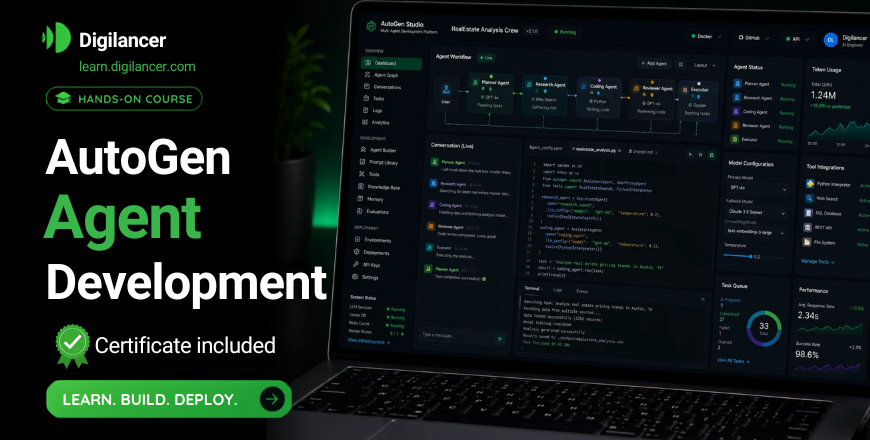
Building Agent using AutoGen
FreeArtificial Intelligence is evolving beyond traditional chatbots into intelligent, autonomous agents capable of reasoning, collaborating, and solving complex problems with minimal human intervention. Building Agents using AutoGen is a comprehensive course designed to introduce learners to Microsoft AutoGen, one of the leading frameworks for developing AI-powered multi-agent systems. Whether you’re an AI enthusiast, software developer, or machine learning practitioner, this course provides the knowledge and practical skills needed to build intelligent agent-based applications using modern Large Language Models (LLMs). The course begins by introducing the fundamentals of AutoGen and guiding learners through the complete environment setup and installation process. Students will configure the required development tools, install the AutoGen framework, and prepare their systems for building and testing AI agents. This foundation ensures learners are ready to develop scalable agent-based applications throughout the course. As learners progress, they will explore the architecture of AutoGen and understand how intelligent agents communicate, reason, and execute tasks using Large Language Models. The course demonstrates how to build a first AI agent from scratch while explaining the internal working of agents, including message passing, reasoning, memory management, and conversation handling. Students will gain a deeper understanding of how autonomous agents make decisions and collaborate to solve complex problems. The course also explores advanced AutoGen capabilities, including AutoChat, multi-model support, multimodal inputs, and structured outputs. Learners will discover how to integrate different language models into a single application, process text and image-based inputs, and generate structured responses suitable for enterprise applications. These concepts enable developers to build more flexible, intelligent, and production-ready AI systems. A key focus of the course is multi-agent collaboration, where learners will create specialized AI agent teams capable of working together to accomplish shared objectives. They will understand how tasks can be distributed among multiple agents, how collaborative decision-making improves problem-solving, and how agent teams can automate sophisticated workflows that would be difficult for a single AI model to handle. The course concludes with a practical capstone project in which learners build a Data Structures and Algorithms (DSA) Solver using an AutoGen agent team. This real-world project combines all the concepts covered throughout the course, demonstrating how multiple AI agents can collaborate to analyze programming problems, generate optimized solutions, validate outputs, and provide structured explanations. By the end of the course, learners will have the confidence to design, develop, and deploy intelligent multi-agent AI applications using the AutoGen framework. What You’ll Learn Understand the fundamentals of Microsoft’s AutoGen framework. Install and configure AutoGen for AI agent development. Learn the architecture and workflow of intelligent AI agents. Build your first AI agent using AutoGen. Understand how AI agents communicate, reason, and make decisions. Explore AutoChat and multi-agent conversations. Integrate multiple Large Language Models (LLMs) into AutoGen applications. Work with multimodal inputs, including text and images. Generate structured outputs such as JSON and formatted responses. Build and manage collaborative AI agent teams. Design scalable multi-agent workflows for real-world applications. Develop a practical DSA Solver project using multiple AI agents. Apply AutoGen concepts to automate complex tasks and intelligent workflows. Build a strong foundation for creating next-generation autonomous AI systems. Target Audience AI Engineers Machine Learning Engineers Python Developers Software Developers Generative AI Developers LLM Application Developers Data Scientists Automation Engineers Computer Science Students Anyone interested in building intelligent AI agents and multi-agent systems Prerequisites Basic knowledge of Python programming. Familiarity with Artificial Intelligence or Machine Learning concepts is helpful but not required. Basic understanding of Large Language Models (LLMs) is beneficial. A computer with Python installed and internet access for installing AutoGen and required dependencies. Enthusiasm to learn modern AI agent development through hands-on examples and real-world projects.View course -
Building LLM Applications using Prompt Engineering
Original price was: $24.99.$9.99Current price is: $9.99.Building LLM Applications using Prompt Engineering is a practical, beginner-friendly course designed to help learners understand how modern Large Language Models (LLMs) can be used to create intelligent applications through effective prompt engineering techniques and AI development workflows. The course introduces the core concepts behind Large Language Models and explores how these models are transforming industries through conversational AI, automation, content generation, knowledge retrieval, and intelligent assistants. Learners will understand how to design prompts, integrate APIs, and build AI-powered systems capable of solving real-world problems. Throughout the course, students will move from foundational concepts to practical implementation. They will explore prompt engineering strategies, learn how to interact with language models programmatically, and understand how conversational workflows are developed using APIs. The course also introduces advanced concepts including Retrieval-Augmented Generation (RAG), fine-tuning techniques, and training workflows that help learners understand how modern AI systems are customized and improved for specialized use cases. By combining conceptual learning with implementation-focused lessons, this course provides learners with the skills required to build modern LLM-powered applications. Course Objectives This course aims to help learners: Understand Large Language Models and their applications Learn prompt engineering principles and best practices Build AI applications using language model APIs Develop conversational workflows using LLMs Explore advanced prompting techniques Understand Retrieval-Augmented Generation (RAG) concepts Learn model customization approaches Understand fine-tuning and training workflows What You Will Learn Fundamentals of LLM Applications Understanding Large Language Models AI-powered application architectures Real-world LLM use cases Components of intelligent systems Prompt Engineering Concepts Prompt structure and design Zero-shot, one-shot, and few-shot prompting Prompt optimization strategies Improving model reliability and consistency Building AI Applications Setting up development environments Working with APIs Creating conversational systems Managing context and interactions Advanced LLM Techniques Retrieval-Augmented Generation (RAG) Fine-tuning concepts Training workflows External knowledge integration Skills You Will Gain By completing this course, learners will develop skills in: Prompt engineering LLM application development API integration Conversational AI design Context management AI workflow design Retrieval-based systems Model customization concepts Who This Course Is For? This course is suitable for: Beginners interested in Generative AI Developers exploring LLM applications Students learning AI technologies Software engineers building AI tools Data science and machine learning learners Anyone interested in prompt engineering Prerequisites Before taking this course, learners should have: Basic computer knowledge Interest in Artificial Intelligence Basic programming knowledge (helpful but not mandatory) No prior LLM experience required Course Outcome By the end of this course, learners will understand how modern language models work, how prompt engineering affects model performance, and how intelligent applications can be built using APIs, prompting techniques, retrieval systems, and conversational workflows. Students will gain practical knowledge that can be applied to real-world AI projects and future advanced LLM development.View course -
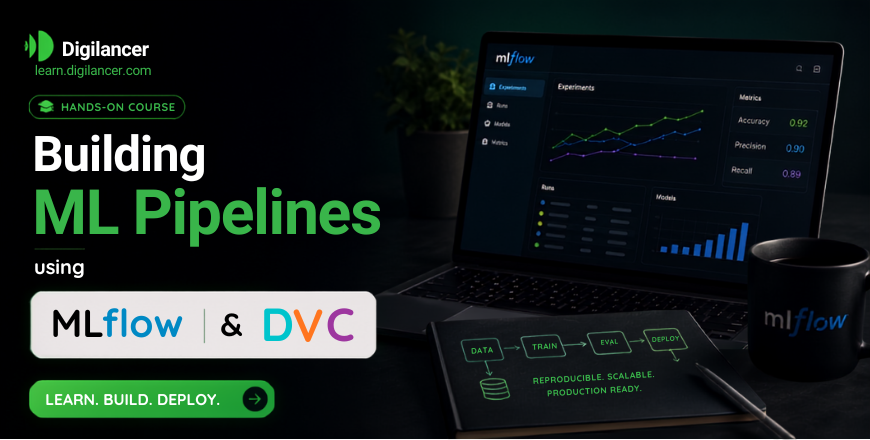
Building ML Pipelines using MLflow & DVC
Original price was: $19.99.$9.99Current price is: $9.99.Machine Learning projects involve much more than simply training models. In real-world environments, organizations require reproducible workflows, experiment tracking, data versioning, automated pipelines, model management, and continuous deployment to ensure reliable and scalable AI solutions. Building ML Pipelines using MLflow & DVC is a comprehensive hands-on course designed to teach learners how to implement modern MLOps practices using industry-leading tools such as MLflow, DVC (Data Version Control), Docker, Flask, GitHub Actions, and AWS. The course begins with the fundamentals of machine learning project development by covering data collection, project planning, and data preprocessing. Learners will understand how to organize datasets, perform exploratory data analysis (EDA), clean and prepare data, and establish structured workflows that improve collaboration and reproducibility throughout the machine learning lifecycle. As the course progresses, students will learn how to implement MLflow for experiment tracking, model versioning, and performance monitoring. They will build and improve baseline machine learning models using feature engineering techniques such as Bag of Words (BoW) and TF-IDF, optimize feature selection, handle imbalanced datasets, perform hyperparameter tuning, and develop ensemble models using stacking techniques. Throughout the process, MLflow will be used to compare experiments, monitor model performance, and manage the complete experimentation lifecycle. The course then introduces Data Version Control (DVC) to build scalable, modular, and reproducible machine learning pipelines. Learners will develop reusable pipeline components for data ingestion, preprocessing, model training, model evaluation, and model registration while understanding how DVC integrates with Git to manage datasets and automate ML workflows. These practices enable teams to collaborate efficiently and maintain consistent machine learning projects across different environments. Moving beyond model development, the course demonstrates how to transform trained machine learning models into production-ready applications. Learners will build REST APIs using Flask, integrate machine learning models with a Google Chrome Extension, and create complete end-to-end AI solutions capable of delivering real-time predictions through user-friendly interfaces. Finally, the course focuses on modern deployment and automation using Docker, GitHub Actions, and AWS. Students will containerize machine learning applications, automate testing and deployment through CI/CD pipelines, and deploy production-ready ML solutions on the cloud. By combining MLOps, DevOps, cloud computing, and automation, learners will gain practical experience in managing the complete machine learning lifecycle from data collection to production deployment. By the end of this course, learners will possess the skills required to build scalable, reproducible, and production-ready machine learning pipelines using modern MLOps tools and industry best practices. Whether you’re an aspiring Machine Learning Engineer, Data Scientist, or MLOps Engineer, this course provides the practical knowledge needed to develop, manage, and deploy enterprise-grade machine learning systems. What You’ll Learn Understand the complete machine learning lifecycle. Plan and organize end-to-end ML projects. Perform Exploratory Data Analysis (EDA) and data preprocessing. Track machine learning experiments using MLflow. Build and optimize baseline machine learning models. Apply feature engineering techniques including BoW and TF-IDF. Handle imbalanced datasets and improve model performance. Perform hyperparameter tuning and model stacking. Build modular ML pipelines using DVC. Version datasets and automate machine learning workflows. Develop reusable pipeline components for data ingestion, preprocessing, training, evaluation, and model registration. Build REST APIs using Flask for model serving. Integrate machine learning models into Google Chrome extensions. Containerize applications using Docker. Implement CI/CD pipelines with GitHub Actions. Deploy machine learning applications on AWS. Apply MLOps and DevOps best practices for production environments. Target Audience Machine Learning Engineers Data Scientists MLOps Engineers AI Engineers Python Developers Software Developers Data Engineers DevOps Engineers Computer Science Students Anyone interested in building production-ready machine learning systems Prerequisites Basic knowledge of Python programming. Familiarity with machine learning concepts is recommended. Basic understanding of Git and GitHub is helpful. A computer with Python installed. An AWS account (or willingness to create one) for cloud deployment exercises. A desire to learn modern MLOps tools and build scalable machine learning pipelines from development to production.View course -
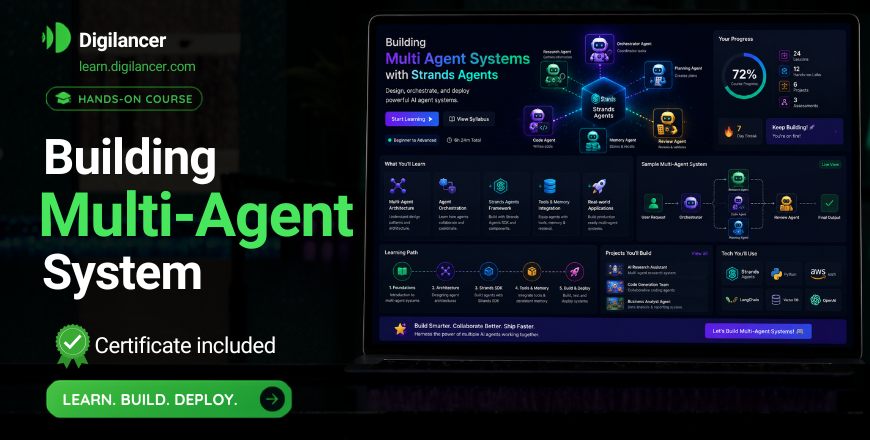
Building Multi Agent Systems with Strands Agents
Original price was: $14.99.$5.99Current price is: $5.99.Building Multi Agent Systems with Strands Agents is a practical course that teaches learners how to design and develop intelligent AI systems where multiple agents collaborate to solve complex problems. Using the Strands Agents framework, learners explore how autonomous agents communicate, coordinate tasks, share information, and work together to achieve common goals. The course introduces the fundamentals of Multi-Agent Systems (MAS), including agent communication, distributed decision-making, and collaborative problem-solving. Learners then explore advanced concepts such as Swarm Intelligence, where agents work collectively through decentralized coordination, and Agent Graphs, which organize agent interactions using structured workflows. The course also covers the Agents as Tools architecture, enabling agents to delegate tasks to specialized agents for greater efficiency and scalability. Through practical examples and real-world use cases, learners gain experience building AI systems for automation, research assistance, workflow orchestration, and enterprise applications. By the end of the course, students will be able to create scalable Multi-Agent solutions that leverage collaboration, delegation, and intelligent coordination to solve complex business and technical challenges. What You Will Learn Fundamentals of Multi-Agent Systems Agent communication and coordination Swarm Intelligence concepts Agent Graph workflows Agents as Tools architecture Task delegation and orchestration Distributed problem solving Building scalable AI systems Real-world Multi-Agent applications Who Should Take This Course? AI Engineers Machine Learning Engineers Generative AI Developers Software Engineers AI Solution Architects Data Scientists LLM Application Developers AI Researchers Automation Engineers Developers interested in Agentic AI Professionals exploring Multi-Agent Systems Prerequisites Basic Python programming knowledge Familiarity with Artificial Intelligence concepts Understanding of Large Language Models (LLMs) is helpful Interest in Agentic AI and workflow automation Basic software development experienceView course -
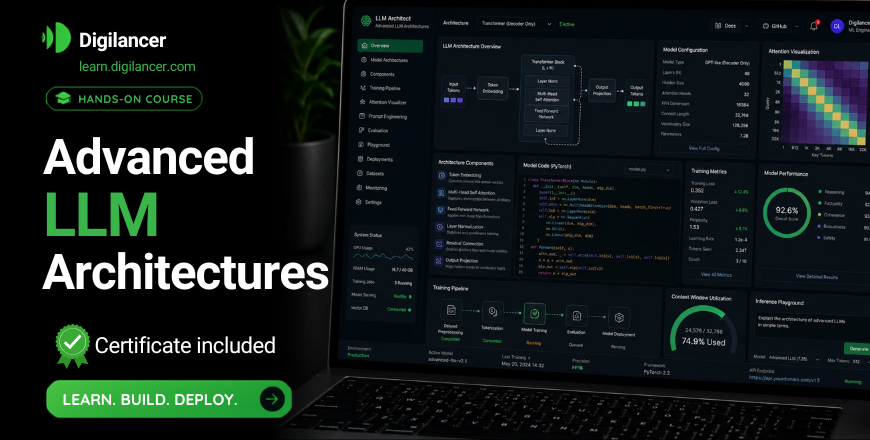
Building Smarter LLMs with Mamba and State Space Model
$24.99As Large Language Models (LLMs) continue to transform artificial intelligence, researchers are exploring new architectures that overcome the limitations of traditional Transformer models. Building Smarter LLMs with Mamba and State Space Model is a comprehensive course designed to introduce learners to the next generation of sequence modeling through State Space Models (SSMs) and the innovative Mamba architecture. The course provides a solid conceptual foundation for understanding how modern AI systems can achieve greater efficiency, scalability, and long-context reasoning. The course begins by introducing the motivation behind State Space Models and examining why alternatives to Transformers are becoming increasingly important. Learners will explore the strengths and weaknesses of Recurrent Neural Networks (RNNs), understand the computational challenges of Transformer architectures, and discover why researchers have turned to State Space Models as a promising solution for building more efficient language models. Moving forward, students will develop a deep understanding of State Space Models by studying their mathematical foundations and different representations, including discrete, recurrent, and convolutional forms. The course explains how hidden states evolve over time, why the A Matrix plays a critical role in state transitions, and how these concepts form the backbone of efficient sequence modeling. Complex topics are presented in a structured and accessible manner, making them easier to understand even for learners who are new to advanced AI architectures. The course then focuses on the Mamba architecture, explaining how it addresses key challenges faced by Transformer-based models. Learners will explore selective state updates, efficient information retention, optimized computation, and the internal structure of the Mamba Block. They will also discover Jamba, a hybrid architecture that combines the strengths of Mamba and Transformers to achieve improved performance for modern AI applications. By the end of this course, learners will have a strong theoretical understanding of Mamba, State Space Models, and modern sequence modeling techniques. They will be equipped with the knowledge needed to understand emerging research in efficient Large Language Models and will be well prepared to explore advanced AI architectures used in next-generation natural language processing systems. What You’ll Learn Understand the evolution of sequence modeling in Artificial Intelligence. Learn why alternatives to Transformer architectures are needed. Explore the strengths and limitations of Recurrent Neural Networks (RNNs). Understand the computational challenges of Transformer models. Learn the fundamentals of State Space Models (SSMs). Study discrete, recurrent, and convolutional representations of SSMs. Understand hidden states, state transitions, and the importance of the A Matrix. Explore the architecture and design principles of Mamba. Learn how Mamba selectively retains important information. Understand how Mamba improves computational efficiency and long-context processing. Explore the internal components of the Mamba Block. Discover Jamba, a hybrid architecture combining Mamba and Transformers. Compare modern sequence modeling architectures and their real-world applications. Build a strong conceptual foundation for advanced AI research and next-generation Large Language Models. Target Audience AI Engineers Machine Learning Engineers Deep Learning Practitioners Data Scientists NLP Engineers Software Developers interested in AI AI Researchers and Students Computer Science Students Anyone interested in modern Large Language Model architectures Prerequisites Basic understanding of Python programming. Familiarity with Machine Learning concepts is recommended. Basic knowledge of Neural Networks is helpful. Understanding of Deep Learning fundamentals is beneficial. Curiosity to learn advanced AI architectures and Large Language Models.View course