

Natural Language Processing: From Basics to Applications





- Description
- Curriculum
- Reviews
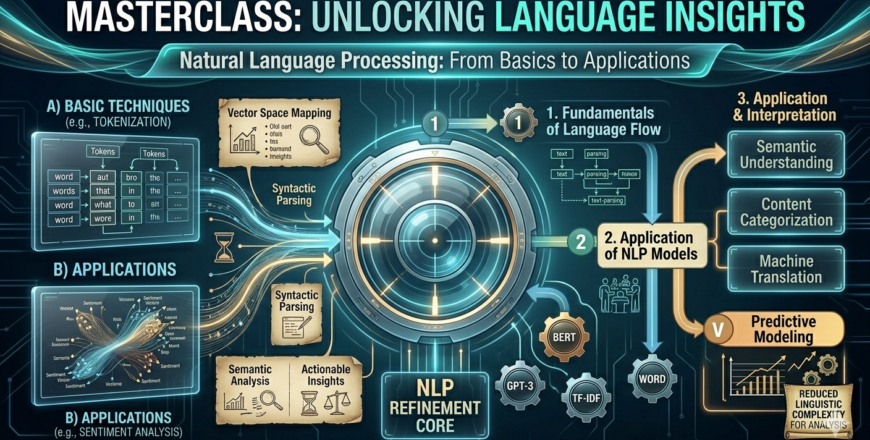
Natural Language Processing: From Basics to Applications is a comprehensive course designed to introduce learners to the exciting field of Natural Language Processing (NLP), a branch of Artificial Intelligence (AI) that enables computers to understand, interpret, analyze, and generate human language. The course takes a practical and structured approach, guiding learners from fundamental NLP concepts to real-world applications used in modern AI systems.
Throughout the course, learners explore how machines process text and speech data, understand linguistic structures, and extract meaningful information from unstructured text. The course begins with the foundations of NLP, including language processing challenges, text representation techniques, and the NLP workflow. Students then learn essential text preprocessing methods such as tokenization, text normalization, stop-word removal, stemming, lemmatization, Part-of-Speech (POS) tagging, and grammar parsing.
The course provides hands-on experience with popular Python-based NLP libraries such as NLTK, enabling learners to implement preprocessing pipelines and perform language analysis on real-world datasets. As learners progress, they discover how text can be transformed into machine-readable formats using feature extraction techniques and vectorization methods.
Advanced topics introduce learners to text classification, sentiment analysis, information extraction, named entity recognition (NER), topic modeling, machine translation, chatbot development, and language generation. The course also explores how machine learning and AI techniques are applied to solve language-related problems across various industries.
Practical exercises, coding demonstrations, and real-world case studies help learners understand how NLP powers applications such as virtual assistants, recommendation systems, search engines, social media monitoring, customer support automation, spam detection, and business intelligence solutions. The course emphasizes both theoretical understanding and implementation skills, ensuring learners can confidently apply NLP techniques in real projects.
By the end of the course, learners will have a strong foundation in Natural Language Processing, understand the complete NLP pipeline, and possess the practical skills required to build intelligent language-processing applications using Python and modern NLP tools.
What You Will Learn
- Fundamentals of Natural Language Processing (NLP)
- Understanding human language and linguistic structures
- Text preprocessing and data cleaning techniques
- Tokenization and text normalization
- Stop-word removal, stemming, and lemmatization
- Part-of-Speech (POS) tagging
- Grammar parsing and syntactic analysis
- Implementing NLP tasks using NLTK
- Feature extraction and text representation
- Text classification techniques
- Sentiment analysis and opinion mining
- Named Entity Recognition (NER)
- Information extraction methods
- Topic modeling and document analysis
- Chatbot and conversational AI fundamentals
- Real-world NLP applications and case studies
Who Should Take This Course?
- Beginners interested in Artificial Intelligence
- Students learning NLP and Machine Learning
- Data Science enthusiasts
- Machine Learning Engineers
- AI Developers
- Data Analysts
- Python Programmers
- Researchers working with textual data
- Professionals interested in text analytics
- Anyone interested in building intelligent language-based applications
Prerequisites
- Basic understanding of Python programming
- Familiarity with programming concepts
- Basic knowledge of Machine Learning (helpful but not required)
- Interest in Artificial Intelligence and language technologies
Course Outcome
Upon completing this course, learners will be able to process and analyze textual data, implement NLP techniques using Python and NLTK, build text-processing pipelines, perform sentiment analysis and text classification, and apply Natural Language Processing techniques to solve real-world problems. They will gain the foundational knowledge needed to pursue advanced studies in AI, Machine Learning, Conversational AI, and Language Technologies.
-
1
 1. Welcome to the Course
This introductory lesson welcomes learners to the course and provides an overview of the learning journey ahead. It outlines the key concepts, techniques, and modules that will be covered, helping students understand how Natural Language Processing (NLP) is used to analyze and extract insights from textual data. Learners will gain a roadmap of the course structure, including NLP fundamentals, regular expressions, and essential text preprocessing techniques required for building effective NLP applications.
-
2
 2. About the Course
This lesson provides a comprehensive overview of the course structure, learning objectives, and the practical skills learners will develop throughout their NLP journey. It highlights the key topics covered in the course and explains how each module contributes to building a strong foundation in Natural Language Processing.
-
3
3. Introduction to Natural Language Processing
This lesson introduces the field of Natural Language Processing (NLP), its significance in artificial intelligence, and the various tasks involved in enabling machines to understand and process human language.
-
4
 4. Exercise : Introduction to Natural Language Processing
 -
5
5. AI&ML Blackbelt Plus Program
This lesson introduces the AI & ML Blackbelt Plus Program, providing an overview of the advanced learning opportunities, career pathways, and specialized skill development available for aspiring AI and machine learning professionals.
-
8
1. Welcome to Module
-
9
2. Tokenization and Text Normalization
Learn the foundational text preprocessing techniques of tokenization and text normalization, which prepare raw textual data for analysis and machine learning applications in Natural Language Processing (NLP).
-
10
3.Exercise : Tokenization and Text Normalization
-
11
4. Exploring Text Data
-
12
5. Part of Speech Tagging and Grammar Parsing
Learn how NLP systems identify grammatical roles within sentences using Part-of-Speech (POS) tagging and grammar parsing techniques to better understand language structure.
-
13
6. Exercise : Part of Speech Tagging and Grammar Parsing
-
14
7. Implementing Text Pre-processing Using NLTK
Learn how to implement text preprocessing techniques using the Natural Language Toolkit (NLTK), one of the most popular Python libraries for Natural Language Processing.
-
15
8. Exercise : Implementing Text Pre-processing Using NLTK
-
16
9. Build a Basic ML Model for Text Classification
-
17
3. Exercise : Implementing Regular Expression in Python