

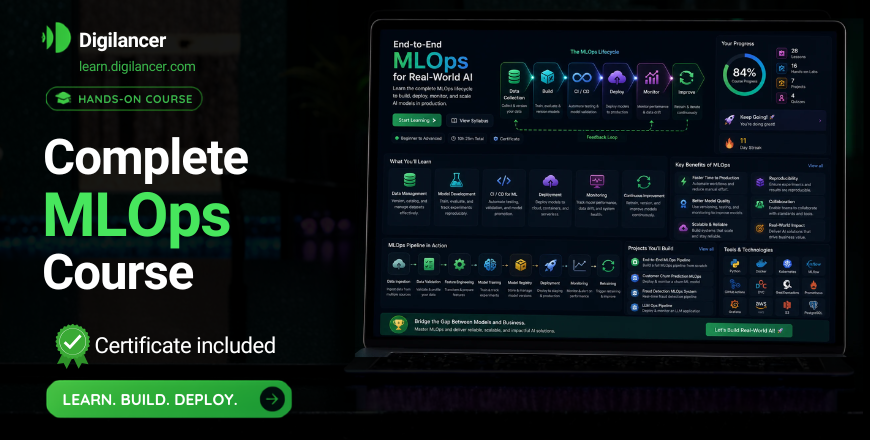
End-to-End MLOps for Real-World AI





- Description
- Curriculum
- Reviews
This comprehensive course, End-to-End MLOps for Real-World AI, is designed to equip learners with a complete understanding of how machine learning systems are developed, deployed, monitored, and maintained in real production environments. Unlike traditional machine learning courses that focus only on model building, this course emphasizes the full lifecycle of machine learning systems, bridging the gap between experimentation and real-world deployment.
The course begins with foundational concepts of MLOps and gradually progresses through real-world challenges in machine learning workflows, including data inconsistencies, model reproducibility issues, deployment complexities, and system scalability problems. Learners will gain a deep understanding of why most ML projects fail in production and how MLOps practices solve these challenges.
In the early sections, students explore basic ML system structures (Level 0 architecture), where workflows are manual and disconnected. As the course progresses, learners are introduced to more advanced architectures, including Level 1 MLOps, where cloud platforms, machine learning frameworks, and partial automation are integrated into the workflow. This transition helps learners understand how real-world AI systems evolve from simple experiments to scalable production systems.
The course also covers critical production concepts such as real-time and batch predictions, model deployment using Streamlit, data drift, concept drift, CI/CD pipelines for machine learning, workflow orchestration, and monitoring strategies. Special emphasis is placed on best practices that ensure reliability, reproducibility, and maintainability of ML systems at scale.
By the end of this course, learners will be able to design and implement end-to-end machine learning pipelines, deploy models into production environments, monitor system performance, and apply industry-standard MLOps practices used in modern AI companies.
What You Will Learn:
- Fundamentals of MLOps and ML lifecycle management
- Real-world challenges in machine learning systems
- Level 0 and Level 1 MLOps architectures
- Cloud integration for scalable ML systems
- Machine learning frameworks and tools
- Real-time and batch prediction systems
- Model deployment using Streamlit
- Data drift and concept drift monitoring
- CI/CD pipelines for machine learning
- MLOps best practices for production systems
Who This Course Is For:
- Students and beginners in machine learning
- Aspiring MLOps engineers
- Data scientists transitioning to production roles
- Software engineers entering AI/ML domain
- Anyone interested in building real-world AI systems
Learning Outcomes:
By the end of this course, learners will be able to:
- Understand the complete ML system lifecycle
- Design scalable and production-ready ML pipelines
- Deploy machine learning models into real applications
- Monitor and maintain ML systems in production
- Apply professional MLOps practices used in industry
-
1
 1. Course Introduction
This lesson introduces the complete MLOps learning journey, explaining how machine learning evolves from experimentation to production-grade systems used in real-world applications.
-
2
2. The Challenges in ML Workflow
This lesson explains the practical challenges faced when machine learning models move from development environments into real-world production systems.
-
3
3. General Challenges
This lesson highlights broader organizational and technical challenges that affect the scalability and efficiency of machine learning systems.
-
4
4. Blueprint of Level 0 Architecture
This lesson introduces Level 0 MLOps architecture, explaining how basic machine learning systems operate without automation or pipeline integration.
-
5
5. Hands-on with Level 0 Architecture Part - I
This practical lesson demonstrates the initial implementation of a Level 0 ML pipeline, focusing on data preparation and model training in a manual workflow.
-
6
6. Hands-on with Level 0 Architecture Part - II
This lesson continues the Level 0 implementation by focusing on model evaluation, saving, and manual deployment practices.
-
7
1. Real-time Prediction and Batch Time Prediction
This lesson explains the two major types of machine learning inference systems: real-time prediction and batch prediction, highlighting their use cases, architecture differences, and performance trade-offs.
-
8
2. Model Deployment in Streamlit
This lesson demonstrates how to deploy machine learning models using Streamlit, enabling the creation of simple and interactive web applications for model inference.
-
9
3. Understanding Data Drift and Concept Drift
This lesson explains two critical monitoring challenges in production machine learning systems: data drift and concept drift, and their impact on model performance over time.
-
10
4. Drawback of Level 0 Architecture
This lesson highlights the limitations of Level 0 MLOps architecture and explains why manual machine learning workflows are not suitable for scalable production systems.
-
11
1. Introduction to Cloud Platform
This lesson introduces cloud computing platforms and explains their role in enabling scalable, reliable, and production-ready machine learning systems in modern MLOps environments.
-
12
2. ML Framework
This lesson explains the role of machine learning frameworks in building, training, and deploying models efficiently within structured MLOps pipelines.
-
13
3. Blueprint of Level 1 Architecture Part I
This lesson introduces the foundational structure of Level 1 MLOps architecture, focusing on partial automation and integration of cloud-based components.
-
14
4. Blueprint of Level 1 Architecture Part II
This lesson continues Level 1 architecture design, focusing on model deployment, orchestration, and workflow automation in production environments.
-
15
5. Best Practices for MLOps Mastery!
This lesson presents essential best practices for building scalable, maintainable, and production-ready machine learning systems using MLOps principles.